
In 1639 Puritans arrived in Uncoway, the name given to these parts by the Paugussett people who lived here. The Puritans’ intention was to establish a town, despite the fact it was already occupied. Eventually the Puritans would call the place “Fairfield,” an apt description of the fertile lands that the Paugussett people had cleared and cultivated for hundreds of years. These English settlers erected a Meeting House of rough hewn timbers which would be used for both religious and civic gatherings, the first European building in Uncoway.
This simple structure was soon replaced by a more substantial building in the style of New England churches, with white clapboards and large clear windows. In time it fell into disrepair and was replaced by a much larger building for the growing congregation. Over time as Fairfield became one of the largest and wealthiest towns in Connecticut, larger church buildings would be erected to replace older structures.
As the 18th century went on, Fairfield and First Church, lead by its Pastor Andrew Eliot, became a hot bed of armed rebellion, advocating independence from Great Britain. In response, in 1779British Forces invaded Fairfield, burned the church building, most of the homes and substantial buildings of the Town, laid waste to the fields, barns and farms, and carried off the wealth, bounty, food and livestock of the people. The Town and the Church would not recover for many years.
In 1890 the fifth Meeting House was destroyed by another act of arson, this one never solved. This white clapboard structure was replaced by the current red sandstone building, designed by Josiah Cleveland in the Neo-Romanesque style so popular in the late 19th century. Finished in 1891, it is the sixth building in which the congregation has gathered to worship God, all erected on the same spot. It houses the Sanctuary which is the church’s principal worship space. It originally included the Children’s Chapel, located to the left of the organ, which has fallen into disuse for many years as a storage area and archives. The Webb Room, which originally functioned as the fellowship hall of the church, is at the rear of the sanctuary and is now used for overflow seating, receptions, meetings, etc. Next to it is the Eunoia Room, named for a young women’s club that met there for many years The basement of the 1891 building has been home for Boy Scout Troop 82 for nearly 90 years and the Rhodes Hall Youth Room was created in 2001.
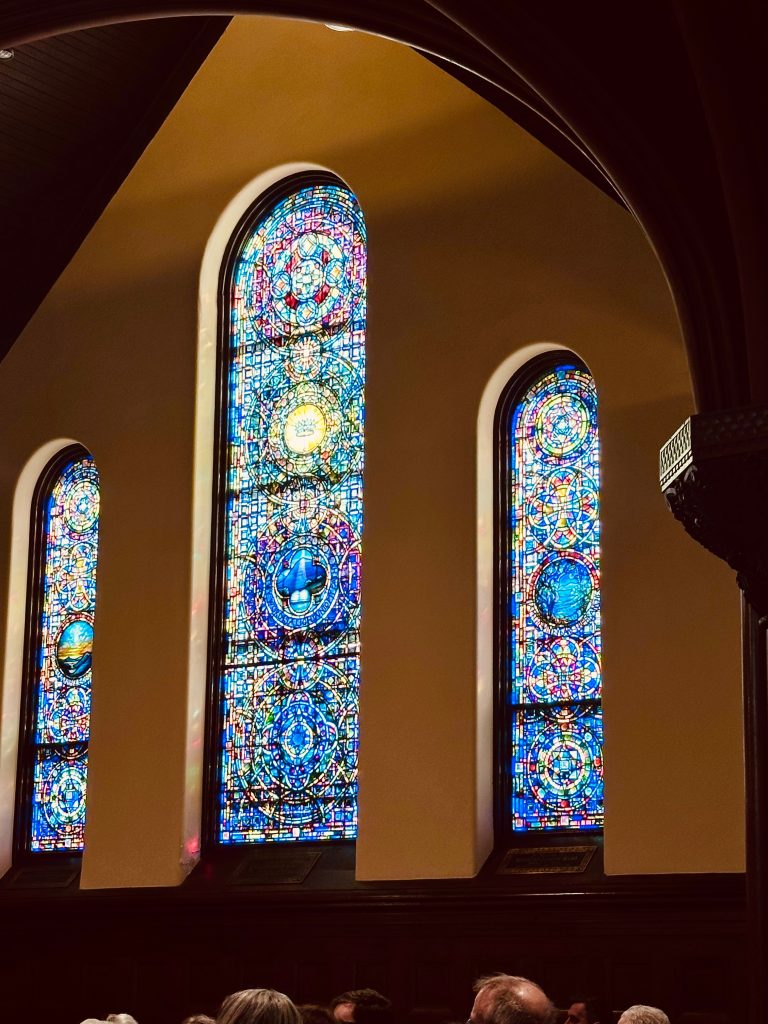
The Tiffany windows were given to the church by two most generous sources: the Jennings Family (one window, three lancets) and J. Sanford Saltus who made a series of gifts which made possible the design and installation of the two Windows given in Memory of the First Six Colonial Ministers, the Children’s Chapel Window, and the three smaller Lancet Pair Windows.
In 1921, the Church erected a free standing Child Memorial Parish House in honor of the beloved Pastor Frank Samuel Child. Structurally separate from the 1891 building, it was built to be a community center with bowling alleys in the basement, where Disciple Road and Twelve Steps groups now meet; with a basketball court where the Dining Room is located; and what was then the largest theater/auditorium in Fairfield, today’s Wakeman Hall. It was all surrounded by small rooms for Sunday School classes, now offices for the Pastors and other members of the Pastoral Team. The Child Parish House has gone through many changes in use over the years!
In 1961, the one story structure was added that joins 1891 Sanctuary to the 1921 Parish House and included a Music Room and lavatories. At the same time the Jones Wing was built, named in honor of the first Pastor of First Church John Jones. This was the height of the Baby Boom and First Church had over a thousand adults and more than 200 children on its rolls. The Jones Wing classrooms housed double sessions of what was then called Sunday School each week. Children would begin each Sunday in the Hobart Chapel, named in honor of Rev. Noah Hobart, who served First Church for 40 years. The wing also housed the Eliot Parlor, which was restricted to use by the Women’s Fellowship only.
Over the years the use of the Jones Wing has changed drastically. By the early 1970’s Sunday School enrollment declined rapidly. Several classrooms were given over to a new venture, The Store, which in the 1979 began selling used clothing and household items to support the church and community partners. The Store is going strong nearly 50 years later, thank God!
Other rooms were also transitioned to weekday Montessori preschool classes, which continue to this day! By 1980, the Hobart Chapel was no longer in use except for occasional weddings or funerals. Its original purpose to nurture children’s faith had gone by the wayside. In 1990 an early worship service was added on Sunday mornings, meeting in the Hobart Chapel. The restrictions on the use of the Eliot Room were relaxed and more church and community groups would come to meet there. Between 2010 -2011 a handicap access door was added in the Connector Corridor and the lavatories were made accessible. The Music was reallocated to become an Elementary Class Room for the Great Beginnings Montessori School.
In 1994 the Church built an addition for The Store, the last structure on the campus. It provides more space for this vitally important part of the Church, with the added benefit of freeing up more space for the Great Beginnings Montessori School which growing under new leadership.
In 2004 the Church purchased the building at 636 Old Post Road. Built on land that the church had originally owned, this structure had been erected to house the Fairfield Historical Society. When the Society decided to build a new Museum on the Town Green, the Church purchased the building to control its future use and development. Since 2005 Operation Hope has rented 636 Old Post Road to house its administrative and support offices, food pantry, and clinical workers.